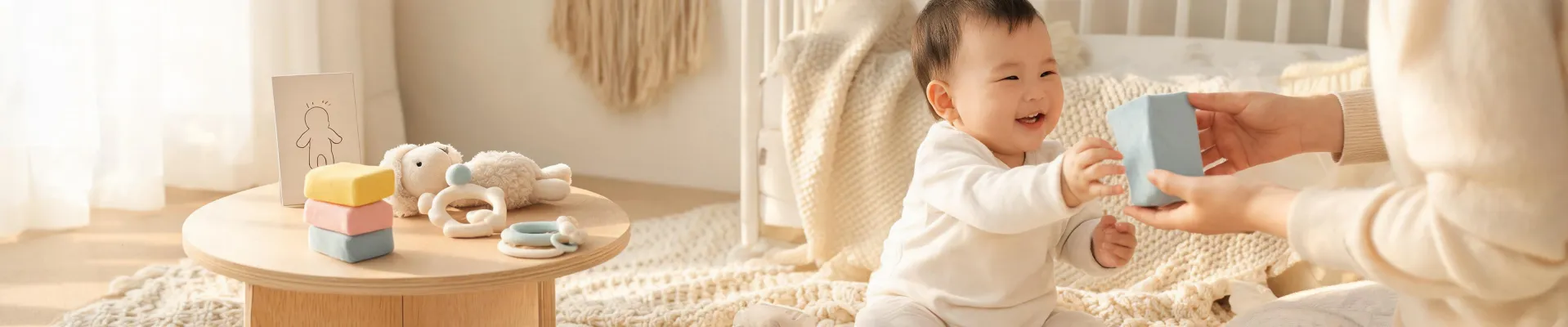
The Fisher-Price Laugh & Learn Jumperoo: What the Bounce Actually Does for Your Baby
2026-08-27 · Miriam Adler
Does the Jumperoo actually help your baby? Yes, if your baby has solid head and neck control and you use it in short, supervised sessions. The real benefit is the cause-and-effect play loop: your baby pushes with their legs, the seat bounces, and lights or sounds reward the effort. It is not a containment device or a walker substitute; it is a stationary activity center that needs your presence. Check readiness and recall status before you buy or set up.
The First Unboxing
You’ve just carried the box into the living room, and the first thing you notice is how much plastic is involved. The Jumperoo arrives in pieces: a frame, a padded seat, a tray covered in toys, and a manual you will probably skim once before tossing it aside. As you snap the legs into place, you catch yourself asking the question every parent asks at this exact moment: is this actually going to help my baby, or is it just another thing that takes up floor space? It is a fair question, because a stationary entertainer looks like a lot of hardware for what seems like a simple bounce. But the answer has less to do with the bouncer itself and more with what your baby does inside it, and when you place them there. What looks like a playpen with springs is really a cause-and-effect laboratory, and the twenty minutes you spend assembling it are the least interesting part of what happens next.
On Fisher-Price’s own site, the Laugh & Learn Jumperoo sits under a category called “Entertainers & Jumperoos,” which is its own shelf, separate from walkers and push toys. That placement matters more than it seems. An entertainer is designed to hold a baby in one spot and reward their movements, while a walker is built to let a child scoot across the floor. The Jumperoo is firmly in the first group. The brand groups it with other activity centers that share a similar job: give a baby a contained, interactive space where they can practice standing, bouncing, and reaching. When you understand that category, the product stops looking like a piece of exercise equipment and starts looking like what it is—a stationary stage for play. The frame you just assembled is the set; the toys on the tray are the props; the bounce is the baby’s cue that something is about to happen. That category distinction also tells you what the Jumperoo is not: it is not a walker, not a bouncer that moves across the room, and not a container for long stretches.
Why the Bounce Actually Matters
Fisher-Price’s site also uses the phrase “Learning Play for Little Ones” and talks about helping babies reach important milestones. That is not just marketing copy; it describes how the Jumperoo works. Your baby’s legs push against the floor, the seat bounces, and that motion triggers a chirp, a light, or a tune from the tray. The cause here is the baby’s own effort—not a motor, not a button you press. The effect is the reward. The toy is engineered so that the reward is never guaranteed—sometimes the light comes on, sometimes the sound does—which keeps your baby testing the relationship again and again. Over a few sessions, your baby starts to connect the two: if I push, something happens. That is an early lesson in cause and effect, and it is the real developmental payoff of this toy. The bounce is not exercise for its own sake; it is the reinforcement that teaches your baby that their movements can control the world. That understanding, not the strength of the bounce, is what carries over into later problem-solving. When you see the tray light up after a kick, you are watching that lesson being learned in real time.
Picture your baby the first time they land a solid bounce and the tray lights up. There is a pause, a look of surprise, and then they do it again—harder. That repetition is the mechanism doing its job. The lights and sounds are designed to reward effort, so the baby is not just flailing; they are testing. They may try bouncing with one leg, then the other, then shifting their weight to see if the toy responds differently. This is active experimentation, not passive entertainment. Over a fifteen-minute session, you will see your baby cycle through playful trial and error, and that is exactly the kind of play that builds persistence. You can practically see the neural loop forming: kick, reward, kick again. That loop is the product, and everything else is just furniture. The toy is not teaching them to jump; it is teaching them that trying again can produce a result. That is a far more useful lesson than the number of inches they travel. And because the reward is unpredictable in its details—sometimes sound, sometimes light—the baby stays curious, which lengthens the window of focused play. The unpredictability keeps the game fresh, preventing the baby from tuning out after the novelty wears off.
Age, Stage, and the Recall Check
The Jumperoo’s box says 6–12 months, and Fisher-Price’s “Big Fun for Little Ones” age bands slot it into that window. But those bands describe the intended play period, not a safety switch that flips on a birthday. What actually matters is whether your baby has solid head and neck control and can sit with support without slumping to one side. A five-month-old with excellent control may be ready before six months; a seven-month-old who still wobbles may not. The band is a convenience for shoppers, not a medical clearance. The real test is simple: place them in the seat for a few seconds and watch whether their head stays upright and centered. The official age range is a planning tool, not a judgment about your specific baby. You can see this in the way Fisher-Price categorizes products: the same site that lists Jumperoos for 6–12 months also keeps separate bands for 0–6 months and 1–2 years. Your job is to read your baby’s readiness, not just the label. That is the difference between using the product as it was designed and forcing a baby into a seat before their body is ready.
There is a reason to check recall status before you buy or set up any baby gear, and it comes straight from CPSC records. In 2007, Fisher-Price recalled about 500,000 “Laugh and Learn” Learning Bunny toys in the U.S., with another 700,000 sold worldwide, because the pink pompom nose could detach and become a choking hazard. The recall date was February 15, 2007, and the toy was a 10-inch-tall bunny—not the Jumperoo. That distinction is important. The recall is not about this product, and it should not scare you off the Jumperoo. What it should do is teach you a habit: before you place your baby in any secondhand or older piece of gear, look up the model number on CPSC.gov or call the manufacturer. Check the product label for a model number and compare it against the recall database; this takes two minutes and costs nothing. When in doubt, call Fisher-Price directly at (800) 432-5437 before your baby plays with the toy. The Jumperoo line itself is not part of that 2007 recall, but the verification step is what turns a brand name into a safety decision.
How to Use It Like a Practitioner
Set the Jumperoo on a flat, carpeted surface if you can. A rug under the frame keeps it from sliding and gives your baby’s feet a little grip. Adjust the seat height so your baby’s feet rest flat on the floor with knees slightly bent—if they are on tiptoes or their knees are jammed up, the bounce won’t work and the position will be uncomfortable. The toy tray should sit at chest level, not chin level, so they can reach the buttons without straining. Before you put your baby in, do a quick check: pull the seat harness snug, make sure the frame locks are fully clicked, and confirm there are no loose pieces within reach. Also tighten the middle support strap if there is one, and give the whole frame a firm shake to make sure it doesn’t wobble. Place the Jumperoo away from walls and furniture so the baby can’t push off and tip the frame. You are aiming for a stable, contained spot where you can see them while you keep one eye on the stove. A final check: make sure the floor is clear of small objects the baby could grab when they lean forward.
The Fisher-Price site places “Walkers & Push Toys” in a separate category from “Entertainers & Jumperoos,” and that separation is a good reminder of how to use the Jumperoo. Do not treat it as a walker substitute: it is stationary, and your baby will not learn to walk by bouncing in it. The Jumperoo is for supervised sessions, not for parking your baby while you leave the room. A good rule of thumb is 15 minutes at a time, a few times a day. Watch for the signs that your baby is done—slumping, fussing, or losing interest in the toys. If they are crying to get out, take them out. Never leave the Jumperoo set up with a baby inside while you nap or take a call. The cause-and-effect play works best when the baby is engaged, and engagement fades quickly past a certain point. Some parents try to stretch the time by adding toys to the tray, but that usually backfires; a cluttered tray makes it harder for the baby to focus on the cause-effect loop. Short, focused sessions give your baby the benefit without turning the toy into a babysitter. Keep the space around the Jumperoo clear so you can move in quickly when the session ends.
The Final Call
So what is the final call? The Jumperoo is worth buying if your baby has solid head and neck control, if you will use it in short supervised sessions, and if you are buying it for the cause-and-effect play loop rather than as a containment device. It is not the right choice if you expect it to replace a playpen, a walker, or your own attention. Your decision rule is simple: match the product to your baby’s current milestones, not to the number on the box, and treat the toy as an activity station that requires you to be present. The litmus test is whether you can be in the room for the whole session without checking your phone. If that feels unrealistic, choose a simpler purchase. Remember that the Jumperoo is a tool for active play, not a storage bin. The real question is not 'does it bounce?' but 'will I be there when it bounces?' If you can do that, the Jumperoo earns its place in your living room. If you cannot, the money is better spent on a play mat and some floor time.
Remember the box you carried in? After you snap the frame together and adjust the seat, you set your baby inside for the first time. They look around at the tray, kick once, and the whole thing lights up with a cheerful song. Their eyes go wide, and they kick again. That is the moment the assembly instructions, the age bands, and the recall check all become worth it. You are not watching a baby bounce; you are watching a baby discover that their own movement made something happen. The same afternoon, you notice your baby trying to kick again even when the music has stopped—they have already learned that effort is worth repeating. That is the payoff you were gambling on when you opened the box, and it is exactly what the field guide promised. That is the field guide in practice, and it is the reason the Jumperoo earns a spot in your rotation—as long as you use it the way it was designed to be used.

Miriam Adler
Miriam Adler is an educational and STEM toy analyst specializing in busy boards, Montessori-style manipulatives, learning towers, sound books, reading pens, pretend-play sets, and early learning toys. She applies ASTM F963 and IEC 62115 methods while evaluating small-part hazards, accessible edges, switch durability, sound output, battery access, pull force, and age-appropriate task complexity. Her work helps parents, retailers, and product teams choose learning products that align developmental goals, supervision needs, interaction design, and the intended age stage.