How the Fisher-Price Laugh & Learn Jumperoo Works (and When to Skip It)
2026-09-03 · Miriam Adler
The Jumperoo is best treated as a short-burst, supervised entertainer for the 0-12 month window. Whether it earns floor space depends on your baby's current stage, your room, and a quick recall check on the exact model before buying or borrowing.
First Bounce: Reading the Room
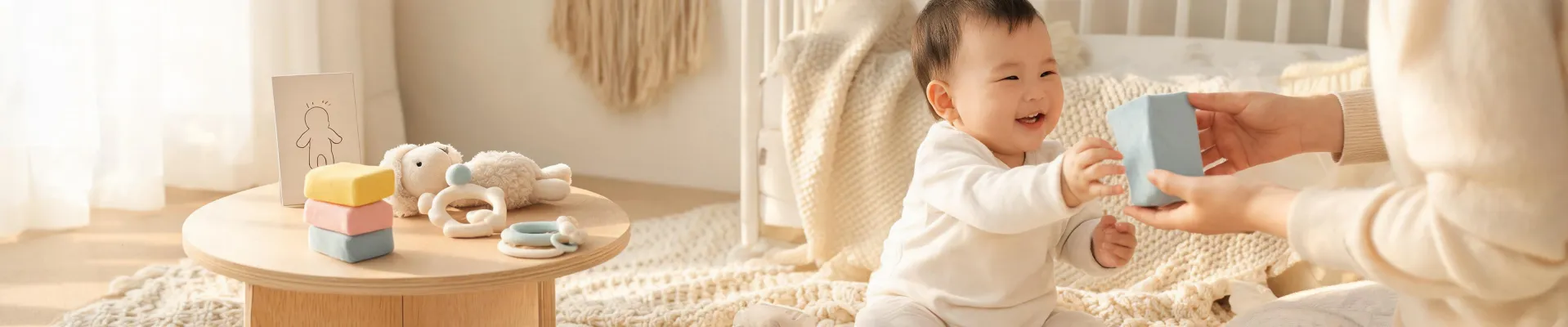
Picture a baby who has just discovered that bouncing is the best thing since the rattle. You set her on the floor mat, she grips the tray, and for the next ten minutes she’s a small astronaut exploring zero gravity—grinning, squealing, and occasionally launching herself high enough to grab a toy overhead. In that moment, the Fisher-Price Laugh & Learn Jumperoo looks like a perfect parenting win. But the questions arrive later, after the batteries have died and the frame is taking up a corner of the living room. Is this toy worth the floor space? Is it actually teaching anything, or just containing a restless infant for a few precious minutes? And what should a parent do when they hear the word 'recall' attached to a Laugh & Learn product?
Fisher-Price’s own website answers the first question with a clear label. On the brand’s navigation, the Jumperoo doesn’t hide among toddler toys or sit next to strollers; it belongs to a category that reads 'Entertainers & Jumperoos.' The same page shows age-stage cards running from '0-6 Months' up through '5+ Years,' which tells you something useful before you ever consider the box’s copy: Fisher-Price positions this as early-stage, active-play equipment. It’s not a sleeper, not a feeding accessory, and not a toy designed for kindergarteners. In practice, the Jumperoo is a short-burst, supervised entertainer for the 0-12 month window, and whether it earns floor space comes down to your baby’s stage, your available room, and your willingness to check the exact model’s recall status before you buy or borrow. The parent who understands that framing can skip the unrealistic expectation that the Jumperoo will grow with a child into the school years. It’s equipment for a specifically brief, active chapter of infancy—one that you’ll likely pass on to another family long before it becomes a dust collector.
What 'Laugh & Learn' Is Reaching For
Look a little deeper at that same product taxonomy and you'll see why the phrase 'Laugh & Learn' works as a marketing umbrella. The Fisher-Price pages that group 'Entertainers & Jumperoos' also carry age-stage cards, with the first card reading '0-6 Months' and the next '6-12 Months.' A brand doesn’t casually attach those ranges; they're part of a logic that separates what a younger baby can attempt while mostly immobile from what requires a toddler’s coordination. That logic is why a jumper frame never appears alongside walkers or push toys in the navigation—it belongs to the short period when a contained bounce is a developmentally reasonable option, not a substitute for independent movement. Notice, too, that the jump seat is grouped under 'entertainers,' not under 'learning' or 'education'—a small but meaningful cue that the company understands what this object actually does: it entertains a baby first, and any milestone boost is a bonus. If you read the category name as a promise of years of use, you’ll be disappointed. If you read it as a gate for the first year, you’re closer to what the brand intends.
That leads to the honest question that the name begs: Does the bounce itself teach anything? Or is the 'learning' just a banner for toys that happen to sit nearby? You won’t find a study taped to the frame—Fisher-Price’s marketing speaks in terms of 'milestones' and 'learning play,' not lab data. Still, the mechanism matters. A baby who is safely held in the seat can push with both legs and watch the result: bounce up, bounce down, repeat. That’s a cause-and-effect loop, and cause-and-effect is one of the earliest cognitive games a baby plays. The loop can also strengthen the muscle groups an infant will later use for standing. None of that turns a jumper into a walker substitute, and it doesn’t replace the messy, whole-body learning that happens during tummy time on a play mat. But it means there is something real behind the word 'learn'—just not the kind of learning a parent might imagine when they see the box.
Fisher-Price’s own line copy makes the learning claim explicit: on its 'Learning Play for Little Ones' section, the brand writes that these toys 'help them reach important milestones.' That’s a frame, not a measurement. When you read it, you should recognize what it’s doing—it invites you to view a stationary entertainer as a development tool. And in a narrow sense, that’s fair. A jumper places a baby in an upright, supported posture where she can experience weight-bearing through her legs, practice grip on the tray toys, and track cause and effect—all skills that support sitting and rolling. The catch is the word 'help.' The toy can contribute to those moments, but it doesn’t deliver them on its own. A caregiver who treats a bounce session as one activity among many—tummy time, free movement, back-and-forth talk—will see more from it than the family that equates the jumper with a curriculum. The brand’s own framing, once you look closely, never promises more than support.
A 2007 Recall, and the Line It Doesn't Cross
Then comes the internet moment that sends every parent to a search bar: 'Laugh & Learn recall.' Type that into Google and you’ll find a CPSC.gov page dated February 15, 2007. It announces a voluntary recall of about 500,000 'Laugh and Learn' Learning Bunny toys in the U.S., with an additional 700,000 sold worldwide. The reason: the pink pompom nose on the yellow bunny—which measures about 10-inches tall—could detach, creating a choking hazard. The remedy listed is a replacement, and Fisher-Price directed consumers to call (800) 432-5437 or visit the firm’s service website. The incident line reads 'None reported.' That date and those numbers are worth keeping in a mental file, because they may be the first and only recall information a current shopper ever sees attached to the Laugh & Learn name. The urge is to generalize the warning to every item in the line.
Resist that urge. The recalled product is the yellow Learning Bunny—a small toy—not the Jumperoo. A Jumperoo is a seated activity center with legs, springs, and a harness; it shares a brand-family name and little else with a 10-inch stuffed animal. Letting one recall poison every product in the Laugh & Learn line is a substitution error. The correct response to a recall isn’t 'avoid Fisher-Price'; it’s 'know exactly which product I’m holding.' Recalls are product-specific, not brand-wide. This 2007 case is still useful, though, as a reminder that small detachable parts are the enemy of infants. It’s also a reminder that any secondhand or hand-me-down baby gear should be checked against current CPSC listings before it sits anywhere near a baby. A recalled bunny from a decade ago tells you to inspect parts and verify model numbers—not to throw out a category.
So when you’re shopping—new or used—your diligence is simple and specific. Write down the exact model name and number from the label, not just 'Laugh & Learn Jumperoo.' Then check the current recall list on the CPSC’s website or Fisher-Price’s own recall page. If you’re buying secondhand, ask the seller for the original box or instructions, and look for any signs that small parts have been replaced or removed. In the vast majority of cases you’ll find nothing—the bunny recall is more than a decade old and covers a different product—but that two-minute check is what separates a confident purchase from a nagging worry. It also sets the habit of reading recall pages as boundary statements, not verdicts on an entire brand. The habit pays off even when the product is brand-new in plastic, because model names change and websites get updated.
Stage Check: Where Your Baby Actually Is
The official Fisher-Price site doesn't publish a bespoke spec sheet for every jumper, but its category cards include the '0-6 Months' range where most babies first try a seated bouncer. The label is a hint, not a guarantee. What matters is your baby’s current ability. She should be able to hold her head up steadily without bobbing, and when you hold her under the arms she should push down with both feet. That combination often shows up somewhere in the 0-6 month window, but every baby is on their own timetable. If she slumps in the seat or her feet dangle, she isn’t ready—the equipment won’t make her ready. If she pushes hard enough to make the frame rock, you’d be wise to shorten sessions or wait until she’s a little stronger. The age cards also remind you that this category is built for the early months; once a child is confidently walking or climbing, a stationary jumper stops being a tool and starts being furniture in the way.
Let’s put that in a specific living room. Your baby is five months old, holds her head up like a champ, and hasn’t started to crawl. You’ve got a corner of free floor near the couch—just enough room for a jumper frame—and a sink full of dishes that would take three minutes if you didn’t have to watch a wobbly infant the whole time. The jumper becomes the obvious answer: strap her in, let her bounce, load the dishwasher. The question is whether those ten minutes move you toward a smarter decision or just a cleaner kitchen. A short, supervised session can absolutely be part of an active day. But if the jumper is the only play the baby gets, or the sessions stretch past the point where she’s bored or tired, you’re not solving a development problem—you’re outsourcing it. Use the ten-minute window as a reset, not as a stand-in for the floor.
The honest usage boundary is time and balance. A contained bounce is a legitimate movement break, but it should never become the default habitat for a baby who could be rolling, reaching, or practicing tummy time on a firm surface. Think of the jumper as a 10-15 minute enrichment station, not a babysitter. Once the novelty wears off—and it will—the same baby who loved the bounce will start fussing to get out. That fuss is your cue to switch. Use the jumper in the window between naps or before a meal, when the baby is alert but not overstimulated. The moment she’s done, she’s done; keeping her in for 'three more minutes' turns a play break into a restraint. And when the session ends, put her down on a mat and give her the space to roll, reach, and explore on her own terms.
So Is It a Yes? (Plus the One Rule to Keep)
So what’s the verdict for your family? The Fisher-Price Laugh & Learn Jumperoo earns a qualified yes—provided you meet three conditions. First, your baby is in that early-stage window: head control is steady, feet reach the floor, and she isn’t yet mobile enough to free-range across the room. Second, you have the floor space and can treat it as a temporary station, not a permanent fixture. Third—and this is the part the brand’s own 'Learning Play' language should prompt—you verify the exact model’s recall status before buying or accepting a secondhand unit. The brand’s line copy says its toys 'help them reach important milestones,' and that verb is doing careful work: a jumper can help, but only when it’s used correctly, in short stretches, and under a caregiver who treats the product as a tool rather than a teacher. If those three conditions hold, the Jumperoo is a reasonable addition to a supervised first-year plan.
Remember the baby who lit up at her first bounce? That image is exactly what a jumper is for—a few glorious minutes of contained joy, not a substitute for the wide-open floor that awaits her. You’ll know it’s working when you can put her in for one session, watch her master the bounce, and then lift her out while she’s still smiling. You’ll know it’s not working when the frame is still there but she’s stopped asking to use it. At that point, pass it on to a friend who can do the same recall check you did. Let the recall history sharpen your inspection habits, not your fear, and let the age cards remind you that this gear owns a short, active chapter in a very long childhood. That chapter ends—and that’s exactly as it should be.
So when that first-bounce grin fades, the Jumperoo has served its chapter. Pass it on with the same recall check you ran, and let the age cards remind you that this gear owns a short, active moment in a very long childhood. That moment ends—and that’s exactly as it should be.

Miriam Adler
Miriam Adler is an educational and STEM toy analyst specializing in busy boards, Montessori-style manipulatives, learning towers, sound books, reading pens, pretend-play sets, and early learning toys. She applies ASTM F963 and IEC 62115 methods while evaluating small-part hazards, accessible edges, switch durability, sound output, battery access, pull force, and age-appropriate task complexity. Her work helps parents, retailers, and product teams choose learning products that align developmental goals, supervision needs, interaction design, and the intended age stage.